
Learning design · E-learning
An undergraduate advanced Python course
A research university needed to teach advanced Python, the genuinely hard parts: metaclasses, decorators, design patterns, concurrency, and working with live APIs, to undergraduates who would tune out a lecture. We built an eight-session course themed around a deep-sea research expedition, where every concept is taught in service of one goal: shipping a working program.
The challenge
Advanced CS concepts that usually lose learners in abstraction, taught to an undergraduate audience that needs a reason to care.
The approach
A narrative arc (deep-sea exploration) where each module unlocks a capability the learner immediately uses in code, built in Articulate Rise for a clean, mobile-ready experience.
The outcome
Learners finish by building a complete, working Python simulation from scratch, the clearest proof that the concepts landed.
Open a session
Open full screen ↗Session 1, exactly as learners experience it. Use the menu and the next arrows to move through it.
The capstone
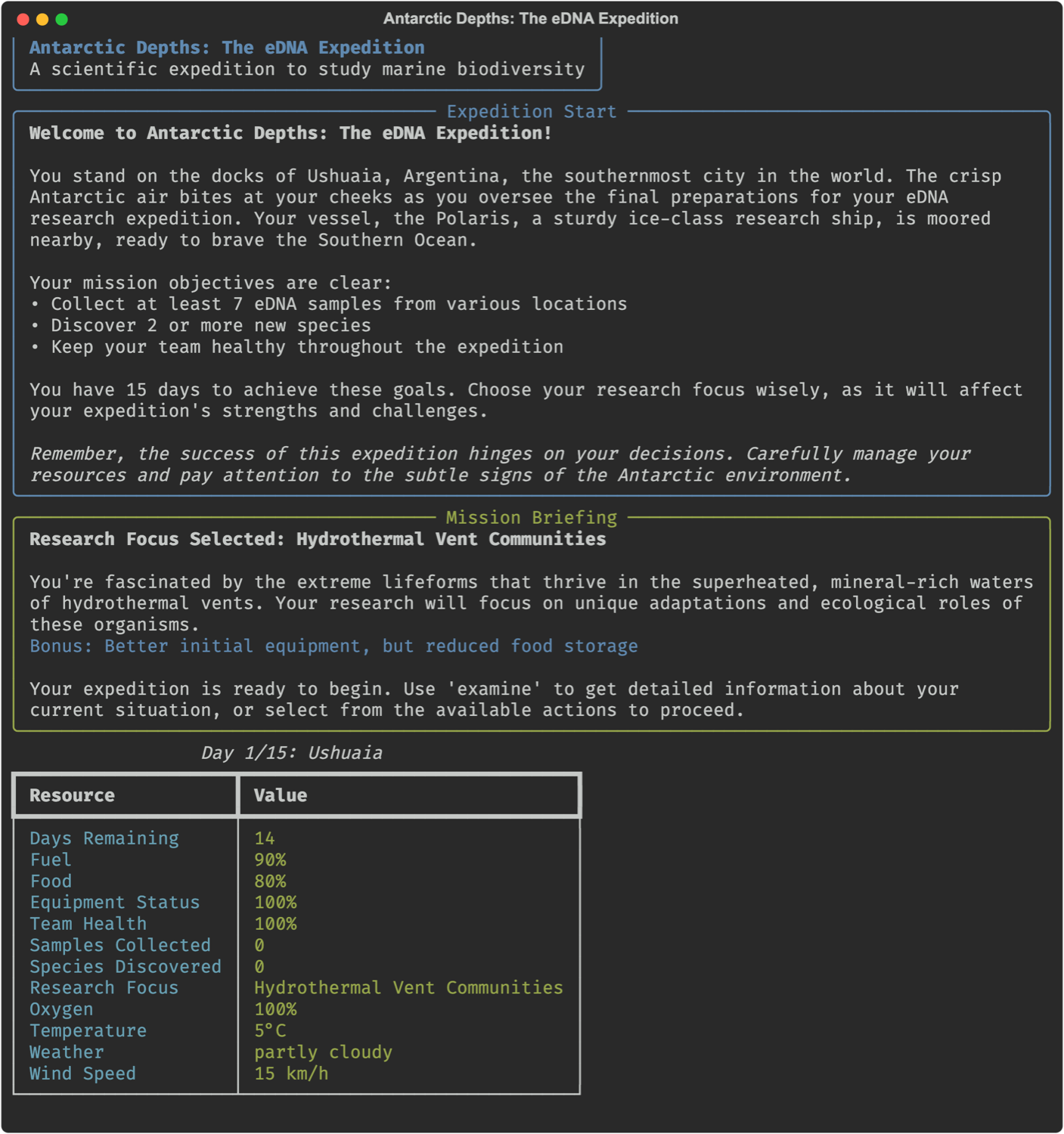
What learners build
The course ends with a real artifact: a playable, text-based research simulation written in Python. Learners manage resources, respond to events, and process data over a fifteen-day expedition, applying every advanced technique the course introduced. It is the difference between knowing what a decorator is and having shipped one that matters.